


If Social Security has approved your disability claim, you may be owed more than your regular monthly checks. Many people also get a lump-sum payment for the time they spent waiting. Here’s how it works and how much you might get.
What Is Back Pay?
Back pay is money Social Security owes you for the months between your disability start date and the date your payments begin. Claims often take months or even years to process, so these unpaid benefits can pile up. Delays and backlogs at the Social Security Administration affect applicants across the country, which is why back pay can add up fast.
What Are Retroactive Benefits?
Retroactive benefits are related but not identical. If you receive Social Security Disability Insurance (SSDI), you may be paid for months before you applied, if the evidence shows you were disabled then. In general, SSDI can reach back up to 12 months before your application date. There is also a five-month waiting period at the start of SSDI, and those months are not paid.
Supplemental Security Income (SSI) works differently. It is possible for back pay to accrue from the month you filed your current application. If you’re not sure which program fits you, this guide to SSI vs. SSDI explains the difference.
How Much Could You Get?
Your total depends on:
- Your monthly benefit amount
- The date your disability began
- The date you filed your application
- How long the decision took
- Whether you qualify for SSDI, SSI, or both
Keep in mind that Social Security sets limits on how far back payments can go. You can read more about them in this explainer on SSDI back pay limits.
Why Having Help Matters
Disability claims are more complicated than they look. Missing medical records, incomplete forms, or a missed deadline can slow your claim down and shrink your back pay. An experienced advocate can:
- Collect and organize your medical evidence
- Strengthen your claim
- Keep you on track with deadlines
- Guide you through an appeal if you’re denied
- Help you get the full benefits you’re owed
Many people who are denied at first win on appeal. To see what that looks like, read what to expect during the disability appeals process.
The Bottom Line
Back pay and retroactive benefits can add up to thousands of dollars. The exact amount depends on when your disability began, when you applied, which program you’re in, and how long your claim takes. Knowing the rules helps you set realistic expectations and avoid leaving money on the table.Whether you’re just applying, waiting on a decision, or appealing a denial, the right support can make a difference. Learn how London Disability helps applicants or request a free case review to discuss your situation with a knowledgeable disability advoc
Applying for Social Security Disability Insurance (SSDI) or Supplemental Security Income (SSI) can feel overwhelming. Between medical records, government forms, deadlines, and appeals, many people find the process confusing and stressful. That is why many claimants choose to work with a disability representative.
But do you really need one?
The answer depends on your situation, but having an experienced representative can often make the process easier and help you avoid common mistakes. Representatives help claimants at every stage of the disability process, from the initial application through appeals and hearings.
What Does a Disability Representative Do?
A disability representative helps you navigate the Social Security disability system. Their job is to guide your claim, gather important evidence, manage deadlines, and communicate with the Social Security Administration on your behalf.
At London Disability, advocates assist claimants at every stage of the SSDI and SSI process, from initial applications through appeals and hearings. They help clients understand where their claim stands, collect medical and supporting documentation, prepare and submit paperwork, track deadlines, and provide guidance throughout the process.
Some of the tasks they may handle include:
- Reviewing your eligibility for SSDI or SSI.
- Helping you complete and submit applications.
- Gathering medical records and supporting evidence.
- Tracking deadlines and required paperwork.
- Representing you during appeals and hearings.
- Explaining what to expect during each stage of your claim.
Why Representation Can Make a Difference
Many disability claims are denied initially, even when applicants have serious medical conditions. If this happens, it does not necessarily mean you do not qualify. The appeals process gives you another opportunity to present evidence and strengthen your case. Many applicants need guidance after a denial and professional support can help them move forward effectively.
A representative understands what Social Security looks for when evaluating disability claims. They can help ensure your medical records clearly show how your condition affects your ability to work and function daily.
When Should You Consider Hiring a Representative?
You may benefit from professional help if:
- You are applying for benefits for the first time.
- You have received a denial.
- You have a hearing scheduled.
- You are unsure whether to apply for SSI or SSDI.
- You feel confused about where your claim stands in the process.
The Bottom Line
Many claimants find that professional guidance reduces stress and helps them navigate a complicated system. Whether you are just getting started, waiting for a decision, or appealing a denial, working with an experienced team such as London Disability can help you better understand your options and focus on building the strongest claim possible.
If you have questions about your disability claim, visit the Frequently Asked Questions page or request a free case review to learn more about your next steps.
Getting approved for Social Security Disability benefits is a big relief. But approval does not always mean your benefits will last forever. Social Security Administration (SSA) regularly checks some disability cases through a process called a Continuing Disability Review (CDR). These reviews help the SSA determine whether you still qualify for benefits.
The good news is that most people who continue to have disabling medical conditions and follow their treatment plans have little to worry about. Understanding how CDRs work can help you protect your benefits and avoid unnecessary problems.
What Is a Continuing Disability Review?
A CDR is a review of your medical condition and ability to work. During the review, SSA looks at your current medical records and other information to decide if your condition has improved enough for you to return to work.
SSA may send you forms to complete or request updated records from your doctors. That’s why it is important to keep good records and stay involved in your medical care.
How to Help Protect Your Benefits
Keep Going to Your Medical Appointments
One of the most important things you can do is continue receiving medical treatment. Regular doctor visits create a record of your condition and help show that your disability is ongoing.
Save Medical Documents
Keep copies of test results, treatment records, prescriptions, and any notes from your healthcare providers. These documents can be helpful if SSA asks for additional information during a review.
Respond to SSA Requests Quickly
If you receive paperwork from SSA, complete it carefully and return it as soon as possible. Missing deadlines can slow down the review process and may affect your benefits.
Be Accurate and Honest
When filling out forms or speaking with SSA, explain your limitations truthfully. Be clear about how your condition affects your daily life and ability to work. Consistent information can help avoid delays and misunderstandings.
Learn More About Disability Benefits
If you’d like to learn more about Social Security disability benefits, London Disability provides guidance by explaining What Is SSDI? and What Is SSI?, and answering common questions on their Frequently Asked Questions page. You can also learn more about the support available throughout the disability process on the How We Help page.
A CDR is a normal part of receiving disability benefits. The best way to protect your benefits is to continue medical treatment, keep your records organized, and respond to SSA requests on time. If you have questions about a disability review or need help with your claim, the team at London Disability can guide you through the process and explain your options. For more information, request a free case review to discuss your situation and get help today.
Being denied Social Security Disability benefits can be frustrating, but it doesn’t mean you won’t qualify. Many people are denied the first time they apply and later receive approval through the appeals process.
Understanding what to expect can help make the process less stressful and help you prepare for what’s next.
Why Disability Claims Are Denied
The Social Security Administration (SSA) reviews thousands of disability applications each year. Claims may be denied because of missing medical records, incomplete paperwork, missed deadlines, or a lack of evidence showing how a medical condition affects a person’s ability to work.
Even individuals with serious health conditions can be denied if their application does not clearly explain their functional limitations. In many cases, additional documentation and stronger medical evidence can improve the chances of approval during an appeal.
Step 1: Requesting Reconsideration
The first stage of the appeals process is usually reconsideration. During this review, a different SSA examiner evaluates your claim, including any new information submitted after the initial decision.
This stage provides an opportunity to strengthen your case with updated medical records, statements from healthcare providers, and evidence of new or worsening symptoms. Continuing medical treatment and maintaining accurate records can help support your appeal.
Step 2: Preparing for a Hearing
If reconsideration is unsuccessful, the next step is often a hearing before an administrative law judge. While this may seem intimidating, it gives applicants the opportunity to explain their situation directly and provide additional evidence.
The judge may ask questions about your medical condition, work history, daily activities, and limitations. Medical or vocational experts may also testify. London Disability helps applicants understand the hearing process and prepare effectively.
What Happens While You Wait?
The appeals process can take time, so it’s important to stay proactive while your claim is under review. Continue attending medical appointments, follow treatment recommendations, keep your records updated, and respond promptly to any requests from SSA.
London Disability offers guidance for applicants who are not sure where they are in the process. Likewise, applicants who are waiting for a decision can learn more about timelines and what actions they should take while their case is being reviewed.
The Importance of Strong Medical Evidence
Strong medical evidence is one of the most important factors in a disability appeal. SSA focuses not only on your diagnosis but also on how your condition limits your ability to perform work-related activities.
Whether your disability involves mental health and emotional wellbeing, pain, mobility and joint conditions, cancer, or another qualifying condition, detailed medical records can significantly strengthen your appeal.
Don’t Navigate the Appeals Process Alone
The disability appeals process involves strict deadlines, detailed paperwork, and multiple levels of review. Professional guidance can help you avoid common mistakes, gather supporting evidence, and present a stronger claim.
London Disability supports individuals nationwide through every phase of the SSDI and SSI process, from initial application through appeals and hearings. Individuals seeking assistance can learn more through the How We Help page or request a free case review to discuss their situation.
A denial is not the end of the process. By staying organized, providing strong medical evidence, and seeking experienced support, you can improve your chances of receiving the benefits you deserve.
When applying for Social Security Disability benefits, medical evidence is one of the most important factors in your claim. Social Security Administration (SSA) does not approve benefits based on a diagnosis alone. Instead, it evaluates how your condition limits your ability to work and perform daily activities. Building strong medical evidence can significantly improve your chances of approval.
Keep Up with Medical Treatment
One of the best ways to support your claim is to continue seeing your doctors regularly. Consistent treatment helps show that your condition is serious and ongoing.
Try to attend all scheduled appointments, follow your doctor’s treatment plan, and let your providers know when your symptoms change. These records help create a clear history of your condition and how it affects your daily life.
Gather Complete Medical Records
SSA reviews medical documentation to understand both your diagnosis and how it affects your ability to function. Strong evidence may include:
- Doctor and specialist treatment notes
- Hospital records
- X-rays, MRIs, and other imaging results
- Laboratory and diagnostic testing
- Surgical reports
- Physical therapy records
- Mental health treatment records
- Medication histories
The more complete your records are, the better SSA can understand your situation. Missing or limited medical evidence is one of the most common reasons disability claims are denied.
For more information about common application mistakes, read Why Was My Disability Claim Denied? Understanding the Most Common Mistakes.
Show How Your Condition Affects Daily Life
A medical diagnosis is important, but SSA also wants to know how your condition limits your ability to work.
Your medical records should explain challenges such as:
- Standing or walking for long periods
- Sitting for extended periods
- Lifting or carrying objects
- Concentrating or remembering information
- Interacting with other people
- Keeping a regular work schedule
Be honest and specific when talking with your healthcare providers about your symptoms and limitations. The more clearly your struggles are documented, the more helpful the records may be.
Ask Your Doctor for Detailed Documentation
Your treating physician can provide valuable insight into your condition. Detailed medical notes and statements explaining your restrictions can help support your claim.
Encourage providers to document objective findings, treatment responses, and functional limitations. Specific information is generally more persuasive than broad statements that simply indicate you have a medical condition.
Stay Organized
Keep copies of important documents, including medical records, test results, appointment summaries, and correspondence related to your claim. Staying organized can help ensure that critical evidence is available when SSA requests it.
Final Thoughts
Strong medical evidence is the foundation of a successful disability claim. By maintaining consistent treatment, gathering comprehensive medical records, documenting your functional limitations, and staying organized throughout the process, you can build a stronger case for the benefits you deserve.
If you need additional guidance, explore London Disability’s resources, including Why Is SSA Denying My Disability Claim? to better understand the disability claims process.
You can also learn more about how London Disability helps applicants or request a free case review to discuss your situation with a knowledgeable disability advocate and take the next step toward securing the benefits you need.
If a medical condition is keeping you from working, you may be thinking about applying for disability benefits through Social Security Administration (SSA). One of the first things you’ll need to understand is whether you should apply for Social Security Disability Insurance (SSDI), Supplemental Security Income (SSI), or both.
While both programs provide benefits to people with disabilities, they have different requirements and are designed for different situations.
Knowing which program fits your circumstances can help you avoid delays, gather the right information, and feel more confident with the application process.
What Is SSDI?
SSDI is a disability benefits program for people who have worked and paid Social Security taxes. To qualify, you usually need enough work credits based on your employment history and a medical condition that prevents you from working or is expected to result in death.
If you’ve worked for years but can no longer work because of a disabling condition, SSDI may be the right program for you.
What Is SSI?
SSI is a disability benefits program for people with limited income and resources. Unlike SSDI, SSI is not based on your work history.
To qualify, you must meet SSA’s definition of disability and fall within certain income and asset limits.
SSI may be an option if you have little or no work history, have not been able to work consistently, or are facing financial hardship because of your condition.
Main Differences Between SSI and SSDI
Both programs require medical evidence showing that your condition significantly limits your ability to work. The biggest difference is how you qualify:
- SSDI is based on your work history and the Social Security taxes you’ve paid.
- SSI is based on your financial situation, including your income and resources.
- You may qualify for both SSI and SSDI in some situations.
Why It Matters Before You Apply
Many people are unsure whether they should apply for SSDI or SSI, which can lead to delays or unnecessary stress during the application process. Understanding which program may apply to your situation and what information SSA needs can help you submit a strong application from the start.
No matter where you are in the process, London Disability provides guidance every step of the way. Whether you’re applying for the first time, waiting for a decision, appealing a denial, preparing for a hearing, or helping a loved one navigate the system, having experienced support can make the process easier to understand and manage.
If you’re not sure whether SSDI or SSI is the right fit for your situation, London Disability can help you understand your options, gather medical records, and navigate the disability claims process with confidence.
Learn how London Disability helps applicants or request a free case review to discuss your situation with an experienced disability advocate.
Receiving a denial letter after applying for Social Security Disability benefits can be confusing and frustrating. If you’re wondering why your disability claim was denied, you’re not alone. Most initial applications are denied due to strict Social Security Administration (SSA) requirements and common, avoidable mistakes.
Insufficient Medical Evidence
One of the top reasons for a disability claim denial is insufficient medical evidence. SSA requires clear documentation not only of your diagnosis, but also how your condition limits your ability to work.
Without detailed treatment records, test results, and documented functional limitations, your claim may not meet SSA standards. Weak or incomplete medical records are a leading cause of denials. To better understand why this happens and how to strengthen your claim, review Why Is the SSA Denying My Disability Claim?.
Missing or Incomplete Application Information
Another common reason for SSA disability denial is incomplete paperwork. Even small errors, like unanswered questions or inconsistent details, can lead to a denial. Incomplete or conflicting information can delay or automatically weaken your claim.
Technical Eligibility Issues
Some disability claims are denied before medical records are fully reviewed. This happens when applicants don’t meet technical requirements, such as:
- Earning above SSA income limits
- Not meeting work history requirements for SSDI
- Not qualifying financially for SSI
These rules are strictly enforced by SSA and can result in an immediate denial.
Condition Not Considered Severe Enough
SSA evaluates whether you can perform any type of work, not just your previous job. If they determine you can adjust to another type of work, your claim may be denied.
Reviewers closely assess your work history and functional limitations during the disability evaluation process.
Lack of Consistent Treatment
A denied disability claim may also result from gaps in medical care, missed appointments, or failure to follow treatment recommendations.
SSA may interpret this as evidence that your condition is not as severe as described, which can significantly weaken your case.
What to Do If Your Disability Claim Is Denied
If your claim has been denied, don’t lose hope. Many applicants are approved after going through the disability appeal process.
London Disability provides nationwide support to individuals navigating the Social Security Disability process, offering guidance at every stage, from initial application to appeal. Our team helps simplify complex requirements by reviewing your case, identifying gaps in medical evidence or documentation, and building a strong claim tailored to SSA standards.
Whether you’re applying for the first time or responding to a denial, get a free case review to help you understand your options and next steps, so you can move forward with greater clarity and confidence.
Social Security Disability (SSD) is one of those programs everyone hopes they never have to become familiar with. If you are studying how Social Security Disability benefits work, it usually means that you or someone you love suffered a serious illness or injury.
But it’s hard for someone suffering from a disability to learn all they need to know quickly. We at London Disability have extensive experience getting our clients their full Social Security benefits, and we know about every rule, regulation, and all the exceptions to the rules. In this blog post, we’ll explain a special provision of the Social Security program called the “5-year Rule” that few people know about.
What Is the 5-Year Rule in Social Security?
Social Security’s 5-Year Rule has to do with people who are fortunate enough to recover from their disability and return to work, only to find out later that they are unable to sustain the rigors of the employment they’ve attempted.
While it may seem rare that someone would be so severely impaired that they qualify for Social Security Disability and yet still recover sufficiently to return to work, it happens more often than you might think.
Social Security Administration defines a qualified “disability” as follows:
A disability is a medically determinable physical or mental impairment that lasts or is expected to last 12 months or longer (or results in death) and prevents the person from performing substantial gainful activities.
Keep in mind that Social Security Disability benefit payments are reserved for people suffering from “long-term” disabilities. The term “permanent” is often used to describe the impairments that afflict Social Security Disability, benefit recipients. However, to qualify for SSD benefits, a qualifying impairment must last 12 months.
In many tragic cases, the disability is truly permanent and never improves. But other people with qualifying disabilities do recover enough over a long period of time to allow them to try to go back to work.
Disability Benefits Continue Through the “Trial Work Period”
Under the old, outdated Social Security Disability program, the government discovered that people whose disability was improving were fearful of trying to return to work because they would lose their SSD benefits.
If they found that they were unable to succeed back at work, they would need to reapply for SSD benefits, and they thought their attempt to return to work would be held against them. They were afraid Social Security Administration would claim that their disability must have been largely healed since the workers felt capable of working.
But Social Security Administration (SSA) wants people to try to go back to work. The government wants to reserve its Social Security Trust fund assets for those people whose disability remains severe. They do not want to continue paying benefits if a benefits recipient is well enough to try working again.
To encourage disabled workers to at least try to work if they feel they are up to it, SSA established the Trial Work Period (TWP) program.
The TWP provides that a person receiving SSD payments can return to work and earn an unlimited amount of income and still continue to receive their full SSD benefit for nine months. The months do not have to be consecutive. A person can try working for a couple of months and then take a break, if necessary, before resuming several months later. The nine months must be used within a period of five years. Any month during which a TWP disability recipient earns at least $1,050 (in 2023) is considered one of the nine months under the TWP program.
Extended Period of Eligibility (EPE) Beyond Nine Month Trial Work Period
When an SSD benefits recipient completes their Trial Work Period and continues to work, their monthly SSD benefits payments will stop. However, for the next 36 months, if the worker’s monthly income falls beneath the SSD income limit, Social Security will pay their full benefit.
THE 5-YEAR RULE
Getting Benefits Reinstated within 5 Years from the Date Benefits Payments Stopped
If, at any time, within five years of your benefits being stopped, your income again falls beneath the level SSA sets as “substantial gainful activities,” you can resume your monthly SSD benefits without needing to reapply.
Your benefits will be reinstated.
All About Encouraging SSD Recipients to Try Working Again
Social Security Administration’s Disability programs are designed to help workers who paid taxes into the system get the financial support they need when they need it.
But when SSD recipients think they might be able to earn income, the SSA wants to support that effort as well. The Trial Work Period, Extended Eligibility Period, and the 5-Year Rule were all created to provide assurance to SSD recipients that their benefits were safe and retrievable if they chose to attempt a return to work. For more information on any of these subjects, contact London Disability today.
When a disability prevents you from working, you are not the only one suffering from a reduction in earnings. Much like you, your family also suffers due to your inability to work and the mounting bills and financial expenses. In such a situation, you may be worried about your children’s financial situation and their ability to meet daily expenses. If you are facing a similar situation and are presently on Social Security Disability Insurance (SSDI) benefits administered by Social Security Administration (SSA), your minor child too can receive monthly cash benefits.
Such benefits paid to a child based on the work record and SSDI eligibility of a parent are called “auxiliary” or “dependent benefits”, and such a child claimant is called an “auxiliary beneficiary”. Auxiliary benefits are available for children whose parents are on SSDI benefits. It does not extend to children whose parents are getting Supplemental Security Income (SSI) benefits from the Social Security Administration.
If you want to win auxiliary benefits for your child, the following conditions must be established:
- You are disabled and unable to work; and
- You have worked long enough at a job or through self-employment and paid sufficient Social Security taxes to qualify for SSDI benefits.
However, other requirements must also be satisfied to win auxiliary benefits for your child.
Auxiliary Benefits for A Dependent Child
For your child to be eligible for auxiliary benefits based on your status as an SSDI beneficiary, the dependent child must be related to you in any one of the following ways:
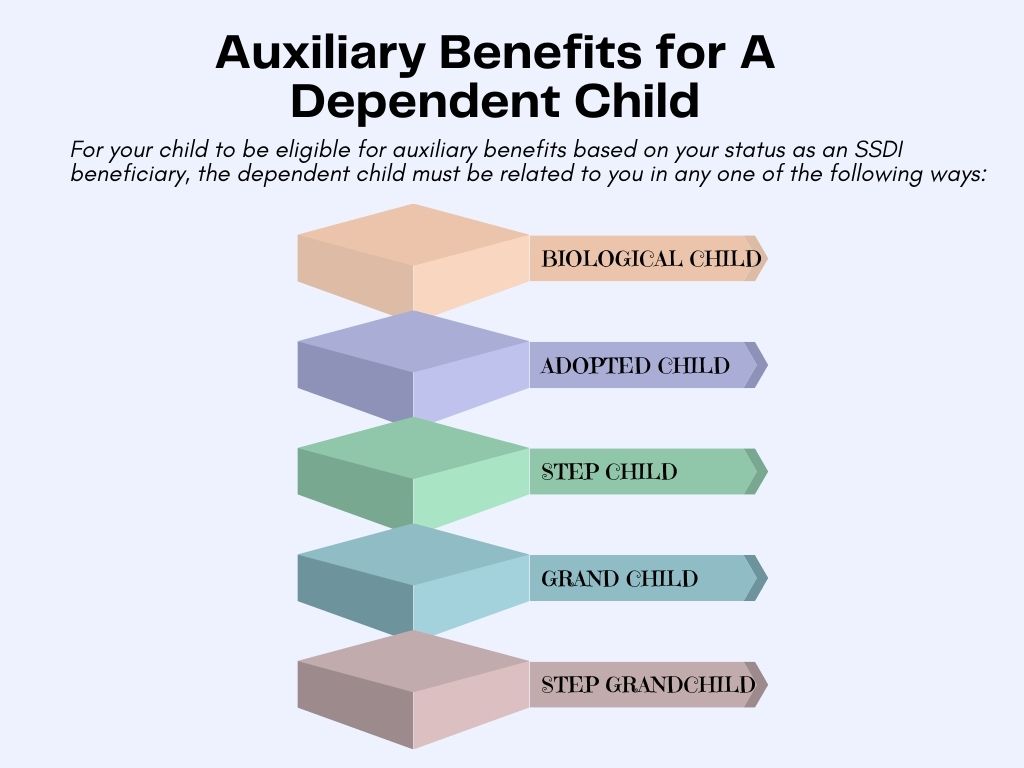
If you are the grandparent of the dependent child, you will also be required to establish that the child is in your legal custody and that there is no living parent. Similarly, in the case of a step-grandchild, you will have to prove that you have adopted the child and that there is no living parent of the child.
Additionally, to win auxiliary benefits based on your Social Security benefits record, you must establish that the child in question is financially dependent on you regardless of whether you are the parent or the grandparent.
However, it does not matter if the child is an offspring of a marital bond. Both children born during or outside marriage are eligible for auxiliary benefits subject to fulfillment of all necessary conditions. The only difference is that in the case of children born outside marriage, the disabled parent must establish paternity for the child to qualify for benefits based on their own Social Security record.
Your Child Will Win Auxiliary Benefits If It Is:
- Unmarried
- Under the age of 18 years; or
- Younger than 19 years of age and a full-time high school student.
If your child started receiving auxiliary benefits but married before turning 18, SSA will stop giving the dependent benefits.
SSDI Benefits for Children with Disabilities
If you are on SSDI benefits, your minor child can get auxiliary benefits even if he does not suffer from a disability. However, if your child is an adult person, then the following conditions must be satisfied for winning benefits based on the parent’s work record:
- The child must be unmarried.
- The child must be disabled.
- The child must have gotten disabled before turning age 22.
Social Security Survivor’s Benefits for Children
If the minor child in question was financially dependent upon his parent, and the parents died while receiving SSDI benefits or had earned sufficient work credits to qualify for SSDI benefits, then such a minor child is qualified for survivor’s benefits. This applies to all unmarried, disabled adult children who have not yet reached age 22.
How Many Dependent Benefits Can Your Child Get?
Your child’s entitlement to auxiliary benefits depends on two main factors:
- The SSDI benefit that you earn as a parent.
- The number of family members getting auxiliary benefits based on your qualification for SSDI benefits.
If you are disabled, your child could receive up to 50% of your SSDI benefit amount. On the other hand, if your child qualifies for survivor’s benefits, the child could get up to 75% of the parent’s Social Security benefits amount.
The SSA has also set a maximum family benefit (MFB) limit to keep the Social Security Disability benefits bill in check. This is the maximum permissible amount that a family can receive in benefits including the SSDI benefits received by the claimant. The MFB is generally 150% to 180% of the disabled person’s SSDI earnings.
Contact An Experienced and Knowledgeable SSDI Benefits Advocate At London Disability Today
If you or a loved one is earning SSDI benefits, you must speak with an experienced and knowledgeable SSDI benefits advocate at our office to understand if your child can qualify for dependent benefits. Contact London Disability today for a free consultation and claim review.