

SSA Benefits for Children of Disabled Parents


4 Mins Reading
4 Mins Reading


When a disability prevents you from working, you are not the only one suffering from a reduction in earnings. Much like you, your family also suffers due to your inability to work and the mounting bills and financial expenses. In such a situation, you may be worried about your children’s financial situation and their ability to meet daily expenses. If you are facing a similar situation and are presently on Social Security Disability Insurance (SSDI) benefits administered by Social Security Administration (SSA), your minor child too can receive monthly cash benefits.
Such benefits paid to a child based on the work record and SSDI eligibility of a parent are called “auxiliary” or “dependent benefits”, and such a child claimant is called an “auxiliary beneficiary”. Auxiliary benefits are available for children whose parents are on SSDI benefits. It does not extend to children whose parents are getting Supplemental Security Income (SSI) benefits from the Social Security Administration.
If you want to win auxiliary benefits for your child, the following conditions must be established:
- You are disabled and unable to work; and
- You have worked long enough at a job or through self-employment and paid sufficient Social Security taxes to qualify for SSDI benefits.
However, other requirements must also be satisfied to win auxiliary benefits for your child.
Auxiliary Benefits for A Dependent Child
For your child to be eligible for auxiliary benefits based on your status as an SSDI beneficiary, the dependent child must be related to you in any one of the following ways:
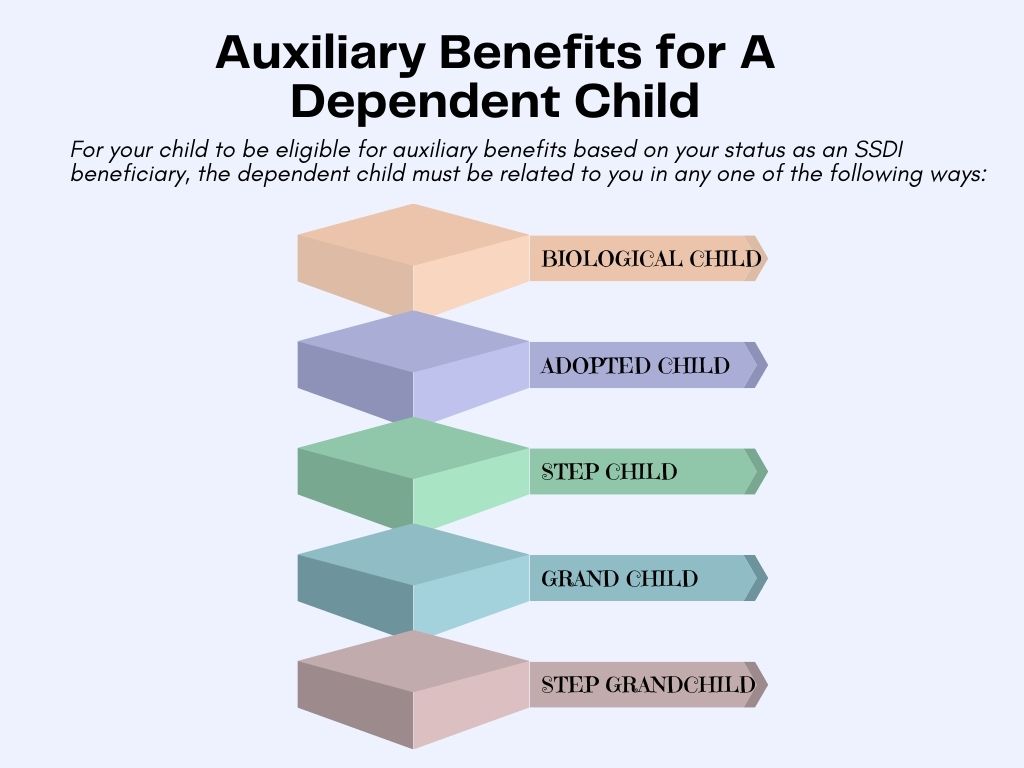
If you are the grandparent of the dependent child, you will also be required to establish that the child is in your legal custody and that there is no living parent. Similarly, in the case of a step-grandchild, you will have to prove that you have adopted the child and that there is no living parent of the child.
Additionally, to win auxiliary benefits based on your Social Security benefits record, you must establish that the child in question is financially dependent on you regardless of whether you are the parent or the grandparent.
However, it does not matter if the child is an offspring of a marital bond. Both children born during or outside marriage are eligible for auxiliary benefits subject to fulfillment of all necessary conditions. The only difference is that in the case of children born outside marriage, the disabled parent must establish paternity for the child to qualify for benefits based on their own Social Security record.
Your Child Will Win Auxiliary Benefits If It Is:
- Unmarried
- Under the age of 18 years; or
- Younger than 19 years of age and a full-time high school student.
If your child started receiving auxiliary benefits but married before turning 18, SSA will stop giving the dependent benefits.
SSDI Benefits for Children with Disabilities
If you are on SSDI benefits, your minor child can get auxiliary benefits even if he does not suffer from a disability. However, if your child is an adult person, then the following conditions must be satisfied for winning benefits based on the parent’s work record:
- The child must be unmarried.
- The child must be disabled.
- The child must have gotten disabled before turning age 22.
Social Security Survivor’s Benefits for Children
If the minor child in question was financially dependent upon his parent, and the parents died while receiving SSDI benefits or had earned sufficient work credits to qualify for SSDI benefits, then such a minor child is qualified for survivor’s benefits. This applies to all unmarried, disabled adult children who have not yet reached age 22.
How Many Dependent Benefits Can Your Child Get?
Your child’s entitlement to auxiliary benefits depends on two main factors:
- The SSDI benefit that you earn as a parent.
- The number of family members getting auxiliary benefits based on your qualification for SSDI benefits.
If you are disabled, your child could receive up to 50% of your SSDI benefit amount. On the other hand, if your child qualifies for survivor’s benefits, the child could get up to 75% of the parent’s Social Security benefits amount.
The SSA has also set a maximum family benefit (MFB) limit to keep the Social Security Disability benefits bill in check. This is the maximum permissible amount that a family can receive in benefits including the SSDI benefits received by the claimant. The MFB is generally 150% to 180% of the disabled person’s SSDI earnings.
Contact An Experienced and Knowledgeable SSDI Benefits Advocate At London Disability Today
If you or a loved one is earning SSDI benefits, you must speak with an experienced and knowledgeable SSDI benefits advocate at our office to understand if your child can qualify for dependent benefits. Contact London Disability today for a free consultation and claim review.
Related Blogs

Back Pay and Retroactive Benefits: How Much Could You Receive?
| Benefits, Payments, Uncategorized

Should You Hire a Disability Representative? What They Do and How They Help
| Applications, Benefits